Research
Publications and preprints
Local Equivalence of Metrics for Multiparameter Persistence
24 April 2020 - arxiv
Abstract
24 April 2020 - arxiv
Abstract
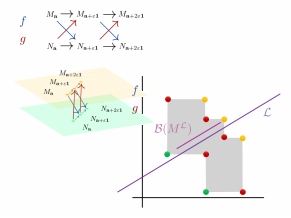
An ideal invariant for multiparameter persistence would be discriminative, computable and stable. In this work we analyse the discriminative power of a stable, computable invariant of multiparameter persistence modules: the fibered bar code. The fibered bar code is equivalent to the rank invariant and encodes the bar codes of the 1-parameter submodules of a multiparameter module. This invariant is well known to be globally incomplete. However in this work we show that the fibered bar code is locally complete for finitely presented modules by showing a local equivalence of metrics between the interleaving distance (which is complete on finitely-presented modules) and the matching distance on fibered bar codes. More precisely, we show that: for a finitely-presented multiparameter module M there is a neighbourhood of M, in the interleaving distance dI , for which the matching distance, d0, satisfies the following bi-Lipschitz inequalities 1/34 d_I (M, N) ≤ d_0(M, N) ≤ d_I (M, N) for all N in this neighbourhood about M. As a consequence no other module in this neighbourhood has the same fibered bar code as M.
Random Čech Complexes on Manifolds with Boundary
18 June 2019 - under review
Abstract
18 June 2019 - under review
Abstract
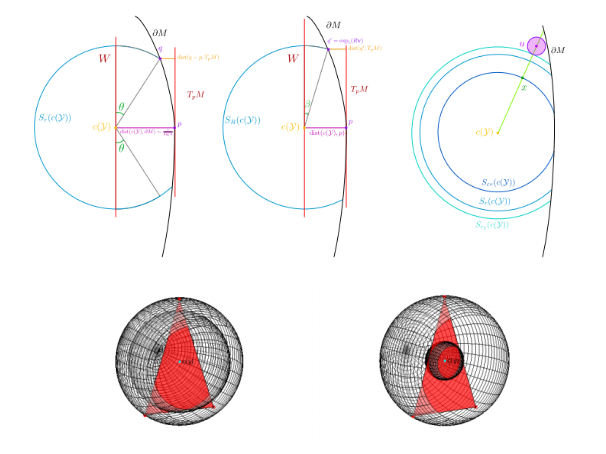
Let M be a compact, unit volume, Riemannian manifold with boundary. In this paper we study the homology of a random Čech-complex generated by a homogeneous Poisson process in M. Our main results are two asymptotic threshold formulas, an upper threshold above which the Čech complex recovers the k-th homology of M with high probability, and a lower threshold below which it almost certainly does not. These thresholds are close together in the sense that they have the same leading term. Here k is positive and strictly less than the dimension d of the manifold. This extends work of Bobrowski and Weinberger in [BW17] and Bobrowski and Oliveira [BO19] who establish similar formulas when M is a torus and, more generally, is closed and has no boundary. We note that the cases with and without boundary lead to different answers: The corresponding common leading terms for the upper and lower thresholds differ being log(n) when M is closed and (2 − 2/d) log(n) when M has boundary; here n is the expected number of sample points. Our analysis identifies a special type of homological cycle, which we call a Θ-like-cycle, which occur close to the boundary and establish that the first order term of the lower threshold is (2 − 2/d) log(n).
Multiparameter Persistence Landscapes
24 December 2018 - Journal of Machine Learning Research
Abstract
24 December 2018 - Journal of Machine Learning Research
Abstract
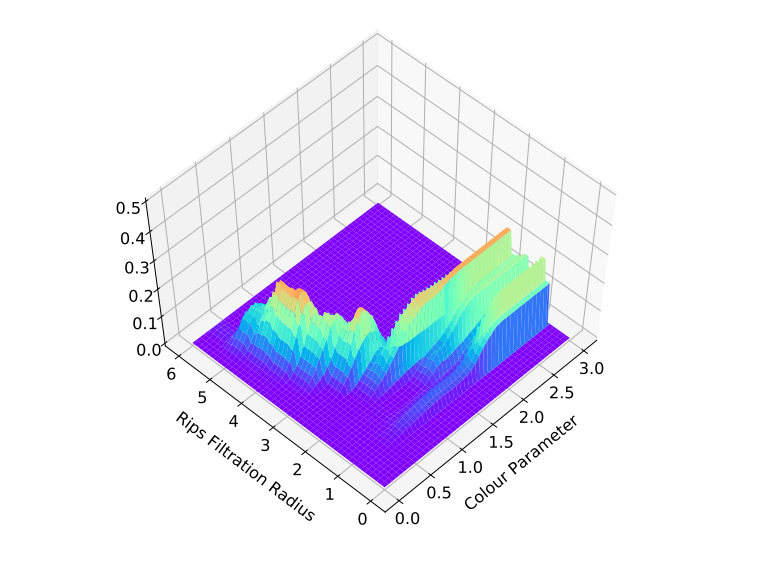
An important problem in the field of Topological Data Analysis is defining topological summaries which can be combined with traditional data analytic tools. In recent work Bubenik introduced the persistence landscape, a stable representation of persistence diagrams amenable to statistical analysis and machine learning tools. In this paper we generalise the persistence landscape to multiparameter persistence modules providing a stable representation of the rank invariant. We show that multiparameter landscapes are stable with respect to the interleaving distance and persistence weighted Wasserstein distance, and that the collection of multiparameter landscapes faithfully represents the rank invariant. Finally we provide example calculations and statistical tests to demonstrate a range of potential applications and how one can interpret the landscapes associated to a multiparameter module.
Talks
Local equivalence of metrics for multiparameter persistence modules
08 April 2020 - Applied Algebraic Topology Research Network
Abstract
08 April 2020 - Applied Algebraic Topology Research Network
Abstract
An ideal invariant for multiparameter persistence should be discriminative, computable and stable. In this work we analyse the discriminative power of a stable, computable invariant of multiparameter persistence modules: the fibered bar code. The fibered bar code is equivalent to the rank invariant and encodes the bar codes of the 1-parameter submodules of a multiparameter module. This invariant is well known to be globally incomplete. However in this work we show that the fibered bar code is locally complete for finitely presented modules by showing a local equivalence of metrics between the interleaving distance (which is complete on finitely-presented modules) and the matching distance on fibered bar codes. More precisely, we show that: for a finitely-presented multiparameter module M there is a neighbourhood of M, in the interleaving distance d_I, for which the matching distance, d_0, satisfies the following bi-Lipschitz inequalities (1/34)*d_I(M,N) ⋖= d_0(M,N) ⋖= d_I(M,N) for all N in this neighbourhood about M. As a consequence no other module in this neighbourhood has the same fibered bar code as M.
Random Geometric Complexes
24 May 2019 - University of Oxford Topological Data Analysis Seminar
Abstract
24 May 2019 - University of Oxford Topological Data Analysis Seminar
Abstract
I will give an introduction to the asymptotic behaviour of random geometric complexes. In the specific case of a simplicial complex realised as the Cech complex of a point process sampled from a closed Riemannian manifold, we will explore conditions which guarantee the homology of the Cech complex coincides with the homology of the underlying manifold. We will see techniques which were originally developed to study random geometric graphs, which together with ideas from Morse Theory establish homological connectivity thresholds.
Multiparameter Persistence Landscapes
17 May 2019 - British Library, Alan Turing InstituteTDA for Histology Data
10 May 2019 - University of Oxford Tumour ClubPersistent Local Systems
25 April 2019 - IST Austria TopApp WorkshopMultiparameter Persistence Landscapes
07 January 2019 - Kyoto University Applied Topology ConferenceReeb Graphs, Extended Persistence and Mapper
19 October 2018 - University of Oxford Applied Algebra and Topology SeminarIntroduction to Persistent Homology
12 October 2018 - University of Oxford Applied Algebra and Topology SeminarMultiparameter Persistence Landscapes
27 April 2018 - University of Oxford Applied Algebra and Topology SeminarSlides
The slides from a few of my talks are available here. Some of the slide transitions and animations do not work with the online version of Powerpoint, but should work if the files are downloaded.
Broadening Courses
Through my PhD programme I have studied courses adjacent to my field of research and written short essays to summarise a topic of interest from each course. Disclaimer: I am not an expert in any of these courses!
-
Computational Learning Theory
Hardness of Learning Parity Functions Under Different Frameworks
-
Machine Learning
Regularisation of Neural Networks
-
Quantum Information Theory
Topological Quantum Computation
-
Category Theory
Model Categories
-
Theories of Deep Learning
Graph Neural Networks -
Combinatorial Algebraic Geometry
Grobner Bases and Newton Polytopes